Quick answer: What can chefs and cooks claim?
You may be able to claim eligible expenses that directly relate to earning your employment income as a chef or cook. Generally, you need to have paid the expense yourself, not have been reimbursed, and keep appropriate records. If an expense is partly private, only the eligible work-related portion should be considered.
Potentially some of them — but not automatically all of them.
Australian tax rules distinguish between genuine work-related tools, occupation-specific or protective clothing and ordinary private expenses. The exact nature of the item matters.
The three basic rules for work-related deductions
You paid for it
You generally need to have incurred the expense yourself and not have been reimbursed by your employer.
It relates to your work
The expense needs the required connection with earning your income as a chef or cook.
You can support it
Keep appropriate records such as receipts, invoices and calculations supporting your deduction.
Common tax deductions for chefs and cooks
✓ Expenses that may qualify
- Eligible chef knives and kitchen tools
- Eligible tool repairs and maintenance
- Occupation-specific chef clothing
- Qualifying compulsory uniforms
- Eligible protective clothing
- Eligible protective footwear
- Laundry of qualifying work clothing
- Eligible work-related training
- Work-related phone use
- Eligible union or professional fees
- Certain work-related travel
- Other eligible equipment used to perform your duties
✕ Generally don't automatically claim
- Ordinary black pants
- Ordinary white shirts
- Normal everyday shoes
- Your everyday meals
- Coffee and snacks during a shift
- Normal home-to-work travel
- Expenses your employer reimbursed
- Private phone use
- Personal grooming
- General clothing simply because it is worn at work
1. Chef knives and kitchen tools
Professional chefs and cooks may purchase their own tools to perform their duties. Depending on your circumstances, eligible work-related tools may include items such as:
- chef knives,
- paring knives,
- boning or filleting knives,
- eligible kitchen utensils,
- certain specialised food-preparation tools, and
- other equipment genuinely required for your current work.
The item must have the necessary connection with earning your income. If it is also used privately, the private use needs to be considered.
Sagar works as a chef and purchases a professional knife that he uses to perform his cooking duties. His employer does not reimburse him.
The work-related cost may be deductible, although how the cost is claimed can depend on the price and applicable tax rules.
2. Can you claim the full cost of expensive equipment?
Not every work-related asset is necessarily claimed in full in the year you purchase it.
Depending on the circumstances, an eligible item costing more than the relevant immediate deduction threshold may need to be claimed over its effective life as a decline-in-value deduction.
If you purchase an expensive knife set, appliance or other work-related asset, check the applicable rules rather than automatically deducting the entire purchase price.
3. Knife sharpening, repairs and maintenance
If you own eligible tools that you use to earn your income, costs you incur to maintain or repair those tools may also be relevant.
For a chef, this could potentially include the eligible work-related cost of professionally sharpening or maintaining chef knives.
Nabin owns the chef knives he uses in his employment. He pays a professional sharpening service to maintain those work knives and is not reimbursed by his employer.
The eligible work-related maintenance cost may be deductible, subject to the usual requirements.
4. Chef uniforms and occupation-specific clothing
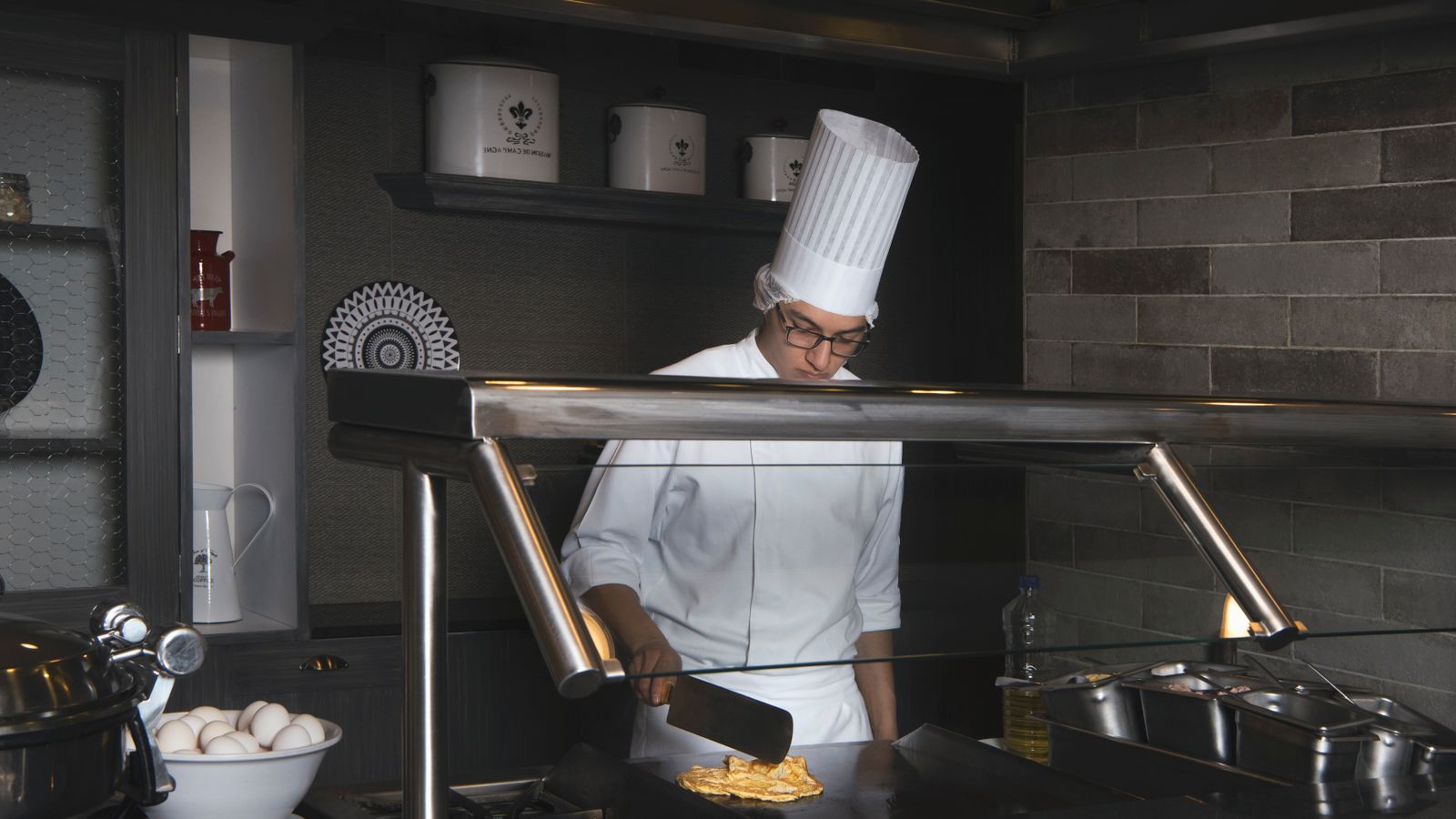
Clothing deductions are an important area for chefs because some chef clothing can be genuinely occupation-specific.
The ATO specifically gives chef's checked pants as an example of occupation-specific clothing.
Occupation-specific clothing is clothing that distinctly identifies you as a member of a particular profession, trade or occupation and is not conventional everyday clothing.
Depending on the circumstances, chef-specific items such as traditional chef clothing may therefore be treated differently from ordinary clothing.
5. Chef hats and other occupation-specific items
A traditional chef's hat is another example of clothing that can distinctly identify the occupation.
Where the clothing qualifies as occupation-specific and you incur the expense yourself, the eligible cost may be deductible.
The same principle does not mean every item worn in a kitchen is automatically occupation-specific.
6. Aprons and protective clothing
Protective clothing may be deductible where it protects you from a real risk of illness or injury at work or protects your ordinary clothing from damage caused by your work environment.
Depending on its nature and purpose, an apron used in a commercial kitchen may potentially qualify as protective clothing.
Other qualifying protective items may also be relevant where they genuinely protect against workplace risks.
7. Protective gloves
A commercial kitchen can involve hot equipment, sharp tools, food handling and other occupational risks.
Eligible protective gloves you purchase to protect yourself while performing your work may potentially be deductible.
The item needs to have a genuine protective function rather than simply being an ordinary personal item.
8. Can chefs claim work shoes?
This depends on the type of footwear.
Ordinary shoes are generally private, even if your employer requires you to wear a particular general style or colour.
However, footwear with genuine protective features may potentially qualify where it protects you from a specific risk of illness or injury in your work environment.
9. Black pants and white shirts
This is one of the most common hospitality deduction mistakes.
Ordinary black trousers, plain white shirts and other conventional clothing are generally not deductible simply because your restaurant or employer requires you to wear them.
This remains the case even if:
- you only wear the clothes at work,
- your employer specifies the colour,
- the clothing becomes dirty during kitchen work, or
- you personally think of it as your work uniform.
10. Laundry expenses for chef clothing
If the clothing itself qualifies for a deduction — for example, eligible occupation-specific, protective or qualifying uniform items — you may also be able to claim eligible costs of cleaning, repairing or laundering those items.
The ATO accepts a reasonable basis for calculating certain self-laundry costs. A commonly used reasonable basis is:
- $1 per load where the load contains only work-related clothing, or
- 50 cents per load where the load contains both eligible work clothing and other laundry.
Read: Uniform, Work Clothing and Laundry Deductions for Nepali Workers .
11. Can chefs claim meals eaten at work?
Usually, ordinary meals, drinks, coffee and snacks are private expenses.
Working around food does not make your own everyday meals deductible.
Bikash works an evening shift as a cook. During his break, he buys dinner and a drink.
The meal is generally a private expense. Buying it because he is at work does not, by itself, make it deductible.
12. What about overtime meals?
Different rules can apply to eligible overtime meal expenses.
Broadly, a deduction may be available in certain circumstances where you work overtime, receive an overtime meal allowance under an industrial instrument and purchase a meal while working overtime.
Receiving money described as a meal allowance does not automatically mean every meal is deductible. Your actual circumstances and the nature of the allowance need to satisfy the relevant rules.
See: Work Allowances vs Reimbursements in Australia .
13. Phone expenses
If you are required to use your personal phone for genuine work purposes, the eligible work-related portion of your phone costs may be deductible.
Examples could include work-related calls or communication with your employer where you incur the cost yourself.
If the same phone is used privately, you need a reasonable basis for determining the work-related portion.
A chef uses his personal phone to communicate with his kitchen manager about shifts but also uses the phone extensively for private calls, social media and entertainment.
He should not simply claim 100% of the phone bill. Only the eligible work-related portion should be considered.
Read: Phone and Internet Tax Deductions for Nepali Workers .
14. Training and self-education expenses
Chefs often undertake courses, workshops or training to improve their professional skills.
Eligible self-education expenses may be deductible where the education has the required connection with your current income-earning activities.
For example, training that maintains or improves specific skills you use in your current chef employment may potentially qualify.
Read: Self-Education Tax Deductions for Nepali Workers and Students .
15. Food safety and work-related courses
If you personally pay for eligible training that is sufficiently connected with your current duties, the cost may potentially be deductible.
For chefs and cooks, this could potentially include relevant training that maintains or improves skills required in their existing employment.
Whether a particular course qualifies depends on what you currently do for work and the relationship between the course and those duties.
16. Travel between restaurants or workplaces
Your ordinary trip between home and your regular workplace is generally private and not deductible.
However, eligible travel undertaken while performing your employment duties can be different.
For example, direct travel from one workplace to another workplace may potentially qualify where the relevant requirements are met.
Prakash finishes his shift at Restaurant A and drives directly to Restaurant B where he works a separate job.
Direct travel between two separate places of employment may potentially be deductible. This is different from driving home after Restaurant A and later travelling from home to Restaurant B.
Read our dedicated guide: Travel Between Workplaces Tax Deductions in Australia .
17. Does carrying chef knives make home-to-work travel deductible?
Do not automatically claim your normal home-to-work travel because you carry chef knives.
The ATO's hospitality guidance specifically notes that normal home-to-work travel cannot simply be claimed because you are required to carry items that may be illegal on public transport, with chef knives given as an example.
18. What if you work at two restaurants?
Many hospitality workers have more than one job.
Having two jobs does not automatically make every trip deductible, but direct travel between separate workplaces can potentially qualify.
You should also make sure income from all employers is correctly included when preparing your tax return.
See: Tax Return With Multiple Jobs in Australia .
19. Union and professional membership fees
Eligible union fees and relevant professional association subscriptions can potentially be deductible where the applicable requirements are met.
Joining fees, special levies and other payments can have different tax treatment, so do not automatically treat every membership-related payment as the same type of expense.
Read: Professional Membership & Union Fee Tax Deductions .
20. What if your employer reimburses you?
You generally cannot claim a deduction for an expense if your employer has reimbursed you for that expense.
Maya purchases an eligible work knife for $150. Her employer later reimburses the full $150.
Maya should not simply claim the $150 as though she remained personally out of pocket.
What records should chefs and cooks keep?
Keep your tax records throughout the year rather than trying to reconstruct everything when tax time arrives.
- Receipts for chef knives and tools.
- Invoices for knife sharpening and eligible repairs.
- Receipts for occupation-specific chef clothing.
- Receipts for eligible protective clothing and footwear.
- Laundry calculations for qualifying clothing.
- Course and training invoices.
- Evidence showing how training relates to your current job.
- Phone-use calculations where relevant.
- Union or professional membership records.
- Travel records where claiming eligible work travel.
- Payslips showing relevant allowances.
- Records of employer reimbursements.
Common tax mistakes chefs and cooks should avoid
- Claiming ordinary black pants. Conventional clothing does not become deductible simply because your employer requires you to wear it.
- Claiming all work shoes. Ordinary footwear is generally private. Protective footwear needs genuine protective characteristics relevant to your work.
- Claiming every meal during a shift. Ordinary food and drink expenses are generally private.
- Claiming home-to-work travel because you carry knives. Carrying chef knives does not by itself make normal commuting deductible.
- Claiming 100% of a mixed-use phone. Only the eligible work-related portion should be considered.
- Claiming reimbursed expenses. If your employer reimburses you, you generally cannot also claim the same expense as though you paid it yourself.
- Immediately claiming every expensive tool. Some assets may need to be claimed over time through decline in value rather than deducted in full immediately.
- Keeping no receipts. Work-related expenses still need appropriate evidence and records.
Chef and cook tax deduction guide
| Expense | Potential treatment | Important point |
|---|---|---|
| Chef knives | May be deductible | Must relate to earning your current employment income. |
| Knife sharpening | May be deductible | Must relate to eligible work tools you own and use for work. |
| Chef's checked pants | May be deductible | ATO recognises chef's checked pants as an example of occupation-specific clothing. |
| Chef's hat | May be deductible | Can qualify as occupation-specific clothing depending on the circumstances. |
| Protective apron | May be deductible | Needs to satisfy the rules for protective clothing. |
| Protective gloves | May be deductible | Must genuinely protect against workplace risks. |
| Protective footwear | May be deductible | Needs protective features relevant to workplace injury or illness risks. |
| Ordinary black pants | Generally not deductible | Conventional clothing remains private even when required for work. |
| Plain white shirt | Generally not deductible | Ordinary clothing is generally private. |
| Laundry | May be deductible | Only where you are laundering qualifying deductible work clothing. |
| Ordinary meals | Generally private | Buying food while working does not normally make it deductible. |
| Eligible overtime meal | May be deductible | Specific overtime meal and allowance conditions apply. |
| Work-related training | May be deductible | Needs the required connection with your current employment. |
| Phone use | May be deductible | Only the eligible work-related portion. |
| Home-to-work travel | Generally private | Normal commuting is generally not deductible. |
| Workplace-to-workplace travel | May be deductible | Can qualify where the relevant work-travel requirements are met. |
Chef tax-time checklist
- Collect your income statements and payslips.
- Check income from every hospitality employer.
- Gather chef knife and tool receipts.
- Review eligible tool repair and sharpening expenses.
- Separate occupation-specific clothing from ordinary clothing.
- Check eligible protective clothing and footwear.
- Calculate laundry only for qualifying work clothing.
- Review work-related training expenses.
- Check your work-related phone-use percentage.
- Review union and professional membership fees.
- Separate ordinary commuting from eligible work travel.
- Check whether your employer reimbursed any expenses.
- Keep records supporting each deduction claimed.
Related Hamro Accountant tax guides
Tax Deductions for Hospitality Workers in Australia 2026
Uniform, Work Clothing and Laundry Deductions for Nepali Workers
Tools & Equipment Tax Deductions for Nepali Workers
Self-Education Tax Deductions for Nepali Workers and Students
Work Allowances vs Reimbursements in Australia
Frequently asked questions
Working as a chef or cook in Australia?
Hamro Accountant can help you review chef tools, uniforms, protective clothing, laundry, training and other potential work-related deductions when preparing your Australian tax return.
General information only: This article provides general Australian taxation information and does not constitute personal tax, financial or legal advice. Whether an expense is deductible depends on your employment duties, the nature of the expense, its connection with earning your income, any private use, whether your employer reimbursed you and your individual circumstances. Australian tax rules and ATO guidance can change. Check current ATO guidance and obtain advice appropriate to your circumstances before lodging your tax return.